







thestockeducators.com

The Stock Educators (TSE)

Master F&O Trading

from anywhere in India.

The majority of traders incur losses due to lack of knowledge. Stop risking capital blindly.
Build real money trading setups based on NSE data with our 30-session live online course.
100% Online
Live Sessions
NIFTY & BANKNIFTY
NISM Prep
30 Sessions

What Is the Online Option Mastery Course at TSE?

Online Options Mastery Course is TSE's exclusive F&O training course conducted live by Hemant Sharma, a SEBI Registered Research Analyst with over 10 years of experience in trading NIFTY, BANKNIFTY, and FINNIFTY options.

This advanced program is designed for traders who want to learn professional options trading strategies beyond random buying and selling.

By the end of the course, you will have a complete Trading Plan, Trade Journal, Backtested Strategy, and Risk Management Framework.

30

Live Online Sessions

11

Deep Dive Modules

10+

Years Mentor Experience

100%

Practical Learning

Who Should Join This Mastery Course?

Existing F&O Traders

You are already trading options but losing money or winning inconsistently. This course identifies exactly what is missing: Greeks, sizing, and adjustment techniques.

Stock Investors

Learn how to use covered calls and protective puts to generate income and reduce downside risk in your portfolio.

Complete Beginners

No experience needed. The first seven sessions build every concept from scratch before any strategy is introduced.

Working Professionals

Attend live online evening and weekend batches from home, office, or anywhere in India.

Finance Students (CA/CFA/MBA)

Gain practical NSE market exposure and NISM Series VIII preparation beyond classroom theory.

Business Owners & HNIs

Learn portfolio hedging, income generation, and capital protection with professional risk management.

Students Outside Metro Cities

Access the same quality education from Tier-2 and Tier-3 cities without relocating or travelling.

Ready to Start?

Join serious options traders across India and start your journey today.

Enroll Now

Full 30-Day Curriculum

11 structured modules. Each session is delivered live online. Every class builds on the previous one.

From Day 7 onward every session includes a live market component on NIFTY or BANKNIFTY.

MODULE 1 — Derivatives & Options Foundations (Days 1–4)
Day 1 — Derivatives & why options exist
  • What exactly are derivatives? A clear comparison between forwards, futures, and options to build your base.
  • Why do options even exist? Exploring their real-world purpose, including hedging, speculation, and generating income.
  • How do futures and options stack up against each other? Breaking down the differences in their risk profiles and required capital.
  • What does the Indian F&O landscape look like? Navigating through NIFTY, BANKNIFTY, FINNIFTY, stock options, and understanding weekly vs monthly expiry.
  • What is the honest reality of option buying versus selling? Setting clear, realistic expectations right from the very start.
Day 2 — Calls & puts mechanics
  • How do call and put options actually work? Understanding the specific rights and obligations of both the buyer and the seller.
  • What do these core pricing terms mean? Simplifying strike price, spot price, and premium.
  • How do we define moneyness? Breaking down ITM (In The Money), ATM (At The Money), and OTM (Out of The Money) for both calls and puts.
  • How does leverage truly function here? Deep dive into lot sizes, contract values, and the reality of leverage.
Day 3 — Reading the option chain
  • How do you navigate the NSE option chain? An end-to-end guide on reading the chain effectively.
  • What do all those data columns mean? Demystifying the bid/ask, LTP, volume, and open interest columns.
  • How do you choose the right expiry and handle settlement? Understanding cash-settled indices and how STT (Securities Transaction Tax) works on the sell side.
  • What is the expiry-day ITM STT trap? Learning what this trap is and why it is absolutely critical to avoid it.
Day 4 — Premium decomposition
  • What is hiding inside an option's premium? Separating the intrinsic value from the time value.
  • How does the premium decay as we get closer to expiry? A gentle introduction to theta, which we formalise later on Day 6.
  • How do you know if a premium is expensive or cheap? Understanding the factors that drive option pricing.
  • Why is liquidity a trader's best friend? Learning why you should stick to index and liquid stock options while avoiding wide bid-ask spreads.
MODULE 2 — Greeks, Volatility, Risk & Margin (Days 5–7)

Why is this module structured this way? The Greeks are split across two days, and risk is given its own dedicated session, ensuring no single class feels overloaded.

Day 5 — Greeks I: Delta & Gamma
  • What is Delta and why does it matter? Building a strong intuition for your directional exposure and the probability of your trades.
  • What is Gamma? Understanding the engine behind Delta and how delta itself changes.
  • How do we use Delta practically? Applying it to choose the right strikes and to evaluate your position risk.
Day 6 — Greeks II + volatility
  • What is Theta? Understanding time decay, which acts as the buyer's worst enemy and the seller's primary income source.
  • What are Vega and Rho? Learning about sensitivity to volatility (Vega) and taking a brief look at interest rates (Rho).
  • How do implied and historical volatility differ? Diving into IV rank/percentile, the India VIX, and understanding exactly what it signals to the market.
Day 7 — Risk, money management & margins (the survival module)
  • How do you protect your capital? Mastering risk per trade, position sizing, and understanding the difference between defined-risk and undefined-risk trades.
  • How do margins and risk asymmetry work? Exploring SPAN + exposure, why selling requires large margin, the risk asymmetry between buyers and sellers, and managing gap or black-swan risk for sellers.
  • How do you track your journey? Setting up the options trade-plan and trade-journal templates, along with establishing the weekly/monthly review loop that you will use from here on out.
MODULE 3 — Open Interest & Market View (Day 8)
Day 8 — Open interest analysis & matching strategy to view
  • What is the Open Interest data telling us? Learning to identify long buildup, short buildup, long unwinding, and short covering.
  • How do you look past the noise with PCR and max pain? Learning how to read the Put-Call Ratio and max pain levels critically.
  • Can you find support and resistance in OI? Deriving key levels from open interest and analyzing the change-in-OI versus actual price action.
  • How do you survive the fast decay of weekly options? Specific tactics for weekly-expiry trading and managing fast theta.
  • How do you align your strategy with your market view? Matching the right strategy to whether your view is directional, neutral, or based on volatility.
MODULE 4 — Technical Analysis: Price-Action Core (Days 9–11)
Day 9 — Intro to TA & charts
  • What is the foundation of technical analysis? Exploring its core assumptions and embracing the price-action philosophy.
  • What are the golden rules of price action? Covering the essential principles of price-action trading.
  • Which charts should you actually be looking at? Understanding line, bar, and candle charts, along with how to choose the right timeframes.
Day 10 — Dow Theory & market structure
  • How does the market move according to Dow Theory? Understanding market structure through HH/HL (Higher High/Higher Low) and LH/LL (Lower High/Lower Low) formations.
  • What are the three phases of the market? Learning to spot accumulation, participation, and distribution phases.
  • How do we categorize trends? Differentiating between primary, secondary, and minor trends.
  • Who are you trading against? Identifying the different types of market participants and the common traps they fall into.
  • What is the Advance Theory / ABCD pattern? An exclusive introduction to this proprietary module.
Day 11 — Trend lines, support & resistance
  • What is the correct way to draw a trend line? Establishing the strict rules for drawing them and identifying valid versus invalid lines.
  • How do you map out support and resistance? Using those trend lines to mark critical market levels.
  • What drives the market up and down? Understanding the core concept of demand and supply.
  • How do you know if a level will hold? Learning the rules for assessing the strength of your support and resistance zones.
  • How do you see the bigger picture? Mastering multi-timeframe analysis.
MODULE 5 — Patterns: Candlesticks & Chart Patterns (Days 12–15)
Day 12 — Candlesticks I
  • How is a single candle born? Understanding candle formation across various timeframes.
  • Who is in the Doji family? Getting familiar with the dragonfly, gravestone, and long-legged dojis.
  • What are the major single-candle reversal signals? Spotting the hammer, inverted hammer, hanging man, and shooting star.
Day 13 — Candlesticks II (multi-candle) + context
  • What do neutral and strong momentum candles look like? Identifying the spinning top and marubozu.
  • What are the most powerful two-candle patterns? Spotting engulfing & harami, piercing & dark cloud cover, and tweezer tops & bottoms.
  • What are the most reliable three-candle patterns? Identifying the morning/evening star, three black crows / three white soldiers, and the rising/falling three.
  • Why do most candlestick traders fail? Understanding critical framing: learning explicitly that candlestick signals only matter at support/resistance and with volume confirmation, so you don't trade patterns in a vacuum.
Day 14 — Chart patterns I
  • How does a chart pattern evolve over time? Breaking down the lifecycle and stages of a chart pattern.
  • How do you trade within boundaries? Identifying and trading bullish, bearish, and horizontal price channels.
  • What are the classic reversal structures? Spotting head & shoulders and inverse head & shoulders patterns.
  • How do you trade double tops and bottoms? Recognizing and executing trades on these foundational setups.
  • What are the different types of triangles? Learning to trade ascending, descending, and symmetrical triangles.
Day 15 — Chart patterns II + live practice
  • What other key patterns do you need in your arsenal? Mastering flags & pennants, rising/falling wedges, cup & handle, and rounding top/bottom formations.
  • Can you spot them in the wild? An engaging, live "find the pattern" session directly on real charts.
  • How do you pull it all together? Learning how to seamlessly combine candles, patterns, and S/R into one cohesive, single setup.
MODULE 6 — Foundational Option Strategies (Days 16–18)
Day 16 — Single-leg strategies & the strategy builder
  • What happens when you just buy an option? Analyzing the long call and long put, focusing on directional buying and its hidden theta cost.
  • What happens when you just sell an option? Analyzing the short call and short put, focusing on directional selling along with its margin requirements and risk.
  • How do you evaluate a trade's potential? Calculating payoffs and breakevens, and deciding when to buy versus sell by tying everything back to the IV concepts learned on Day 6.
  • How do you visualize your risk before taking a trade? An introduction to using a strategy builder like Sensibull or Opstra for visualising payoffs.
Day 17 — Hedged & income strategies
  • How can you make money on stocks you already own? Using the covered call strategy for generating income on a holding.
  • How do you insure your portfolio against a crash? Applying the protective put to insure a position.
  • How can you get paid to buy a stock at a discount? Utilizing the cash-secured put to get paid to wait.
  • Why are these the best starting points? Seeing how each strategy reshapes the payoff and the risk, making it the safest place for a beginner to start selling.
Day 18 — Vertical spreads (debit & credit)
  • How do you build debit spreads? Creating a bull call spread or a bear put spread.
  • How do you build credit spreads? Creating a bull put spread or a bear call spread.
  • Why trade spreads instead of naked options? Learning how they reduce cost and cap risk compared to a naked buy, and making the crucial debit-vs-credit decision based on market direction and IV.
MODULE 7 — Neutral & Volatility Strategies + Adjustments (Days 19–20)

When do we learn how to fix losing trades? Adjustment technique is taught right here, alongside the short-premium strategies that actually need it, rather than leaving it for the end of the course.

Day 19 — Straddles & strangles (and how to defend them)
  • How do you trade massive price moves? Using the long straddle or strangle for buying volatility ahead of major events.
  • How do you profit from quiet markets? Using the short straddle or strangle for selling volatility, while deeply understanding the risk it carries.
  • What is the danger of event trading? Navigating corporate/macro events and avoiding the dreaded IV-crush trap.
  • How do you fix a trade gone wrong? Learning your first adjustments to effectively manage a short-premium position that moves against you.
Day 20 — Iron condor (and rolling)
  • How do you build the ultimate range-bound trade? Constructing the Iron Condor to build defined-risk, range-bound income trades.
  • How do you design the perfect condor? Mastering strike and wing selection to balance probability with risk-reward.
  • When should you book profits or cut losses? Establishing strict rules for managing winners and stopping losers.
  • How do you defend a threatened Iron Condor? Using rolling techniques and hedged selling to defend the overall position.
MODULE 8 — Delta-Neutral Monthly Strategy (Day 21)
Day 21 — The delta-neutral monthly strategy
  • How do you set up a monthly income engine? Building a completely delta-neutral monthly position step by step.
  • How do you maintain the balance? Learning the art of keeping it neutral through re-hedging as the underlying asset moves.
  • What is the core trade-off here? Balancing theta capture against gamma/vega risk, and knowing exactly when this strategy works and when it definitely doesn't.
  • How do you allocate capital for this? Managing your position sizing and margin requirements for a monthly carry.
MODULE 9 — Situational Institutions Intraday Strategies (Days 22–24)

How are these specific strategies taught? These are scenario-based playbooks where each day pairs the setup with on-screen backtesting, and then closes the program's theory with a comprehensive pre-live checklist.

Day 22 — Gap-up situations
  • How do you decode a gap-up morning? Learning how to read a gap-up open and identify if it's a trapped-buyer scenario or a continuation scenario.
  • What is the game plan for a gap-up? Executing proper strike and structure selection specifically for a gap-up day.
  • Does this actually work? Backtesting the playbook rigorously on historical gap-up sessions.
Day 23 — Gap-down situations
  • How do you decode a gap-down morning? Learning how to read a gap-down open to distinguish between momentary panic and a genuine breakdown.
  • What is the game plan for a gap-down? Executing proper strike and structure selection specifically for a gap-down day.
  • Does this actually work? Backtesting the playbook rigorously on historical gap-down sessions.
Day 24 — Flat / range situations + pre-live wrap
  • How do you trade a boring market? Navigating a flat, range-bound open using highly effective theta-friendly structures.
  • Does this actually work? Backtesting the flat-day playbook to ensure reliability.
  • Are you truly ready to go live? Walking through the pre-live checklist which includes validation & expectancy recap (covering sample size, win rate, average R, and avoiding curve-fitting); a breakdown of F&O taxation in India (business income, turnover, audit thresholds, and loss set-off); and confirming your weekly/monthly review loop before you start live trading.
MODULE 10 — Practical / Live Trading (Days 25–29)
Days 25–29 — Live Practical Blueprint
  • Day 25 — What is the focus of our first practical session? Applying everything learned so far directly into live market practical trading.
  • Day 26 — How do we build on yesterday's experience? Spending another dedicated day executing live trading setups and observing real-time mechanics.
  • Day 27 — Are we getting comfortable with screen time? Immersing ourselves further into live market conditions to build trading psychology.
  • Day 28 — How are we handling real-time adjustments? Continuing our live trading sessions to practice managing dynamic risk.
  • Day 29 — How do we conclude our live market practice? Wrapping up our final day of dedicated practical and live trading before graduation.
MODULE 11 — Capstone & Graduation (Day 30)
Day 30 — Capstone & graduation
  • What is the final test? Each student takes the floor and presents one fully backtested strategy, complete with written risk rules and a reviewed trade journal.
  • Are there any lingering questions? Hosting a final doubt-clearing and Q&A session to ensure absolute clarity.
  • What do you walk away with? Your own personal trading plan is finalized, reviewed, and officially signed off.

Course Overview — At a Glance

Mode
100% Live Online
Learn from anywhere in India.
Duration
30 Sessions
Spans across 6–8 weeks.
Level
Beginner to Pro
No F&O experience required.
Markets
Nifty & Banknifty
Includes Finnifty & liquid stocks.
New
Strategies
11 Master Setups
From single-leg to Delta-Neutral.
Live
Live Practice
Market Analysis
Real-time trading from Day 7.
Certification
NISM Series VIII
Complete exam prep included.
Batch Size
Max 15 Students
Personal one-on-one mentorship.
Tools Taught
Sensibull & TV
Opstra and Option Chains.
Support
Lifetime Access
Alumni group & monthly reviews.
Trading Course Comparison Matrix

Course Comparison Matrix

Explore elite trading programs designed to build professional clarity

TSE Option Elite

₹25,000/one-time
Enroll Now

TSE Swing Elite

₹25,000/one-time
Enroll Now
Most Popular

TSE Combo Pro Elite

₹40,000/one-time
Enroll Now
Premium Offline

Professional Trading Course 2.0

₹80,000/one-time
Enroll Now

Detailed Course Feature Breakdown

Feature / Topic TSE Option Elite TSE Swing Elite TSE Combo Pro Elite Offline Course 2.0
Market & Investing Foundations
Basic of Stock Market (Primary & Secondary Market)
Technical Analysis – Price-Action Core
Dow Theory & The Big Whale (proprietary module)
Marking support & resistance, demand/supply
Time Study & Multi-timeframe analysis
Candlestick & ChartPattern Setups
Intraday Trading Setups
Option Intraday Scalping Trading Strategy
Option Swing Trading Strategy
Option Delta Neutral Based Adjustment Strategy
Swing Trading Setups
Stock Intraday Trading Strategy
Stock Swing Trading Strategy
Stock Multibegger Identification Strategy
Time Study - The Explosion Moves Flagship Setup
Derivatives & Options Foundations
Calls & puts mechanics (rights/obligations)
Reading the option chain (OI, IV, LTP)
Greeks, Implied vs historical vol, IV rank, India VIX
OI analysis (buildup/unwinding, PCR, max pain)
Option Strategies
Single-leg, Double Leg, 4 Leg Strategies
Hedged Strategies & Margin Benefits
Screening, Backtesting & Automation
Chartink & Screeners Filteration
5 Days Practical with Live Trading and Learning
TSE Crypto Currency Elite Programme
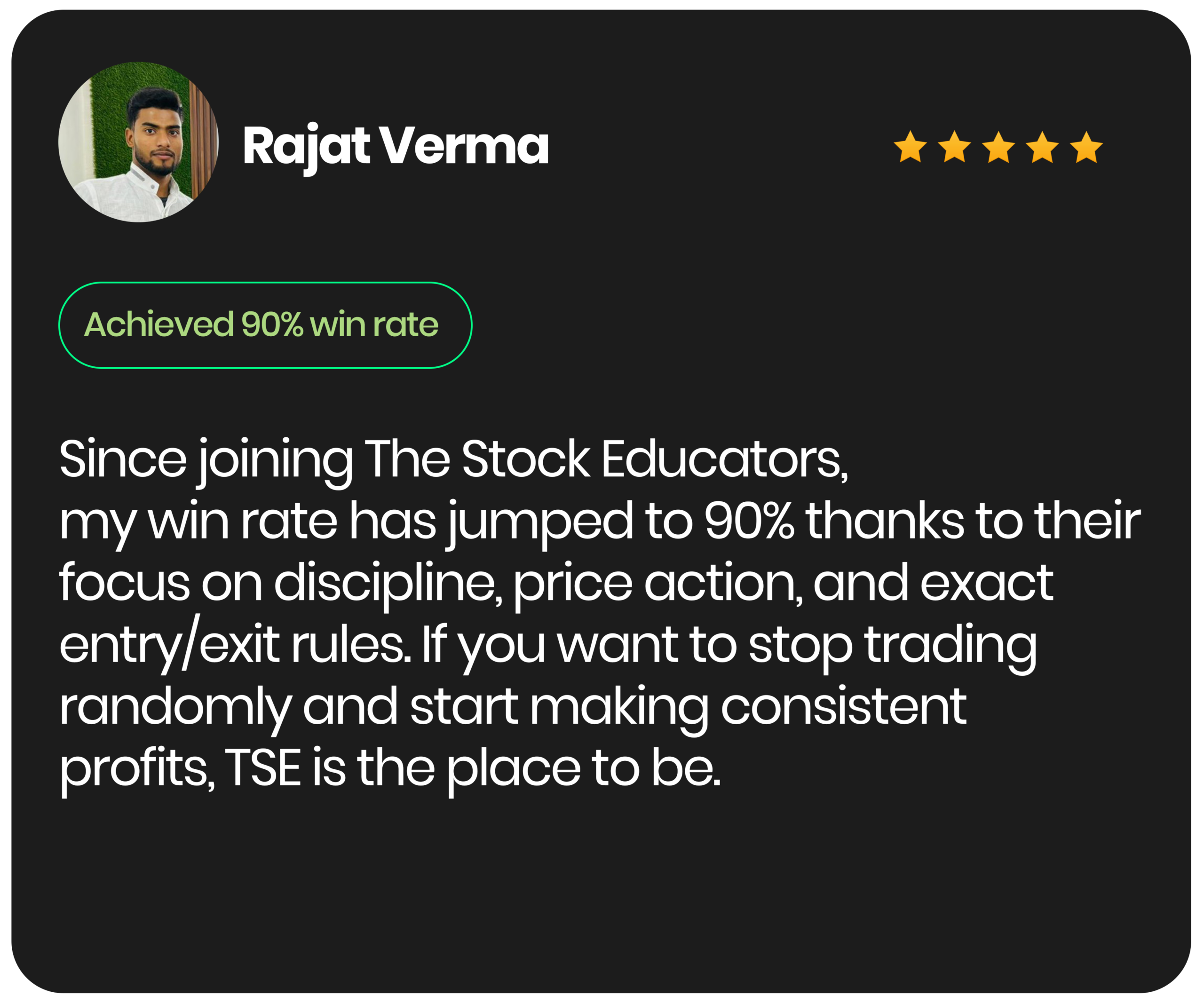
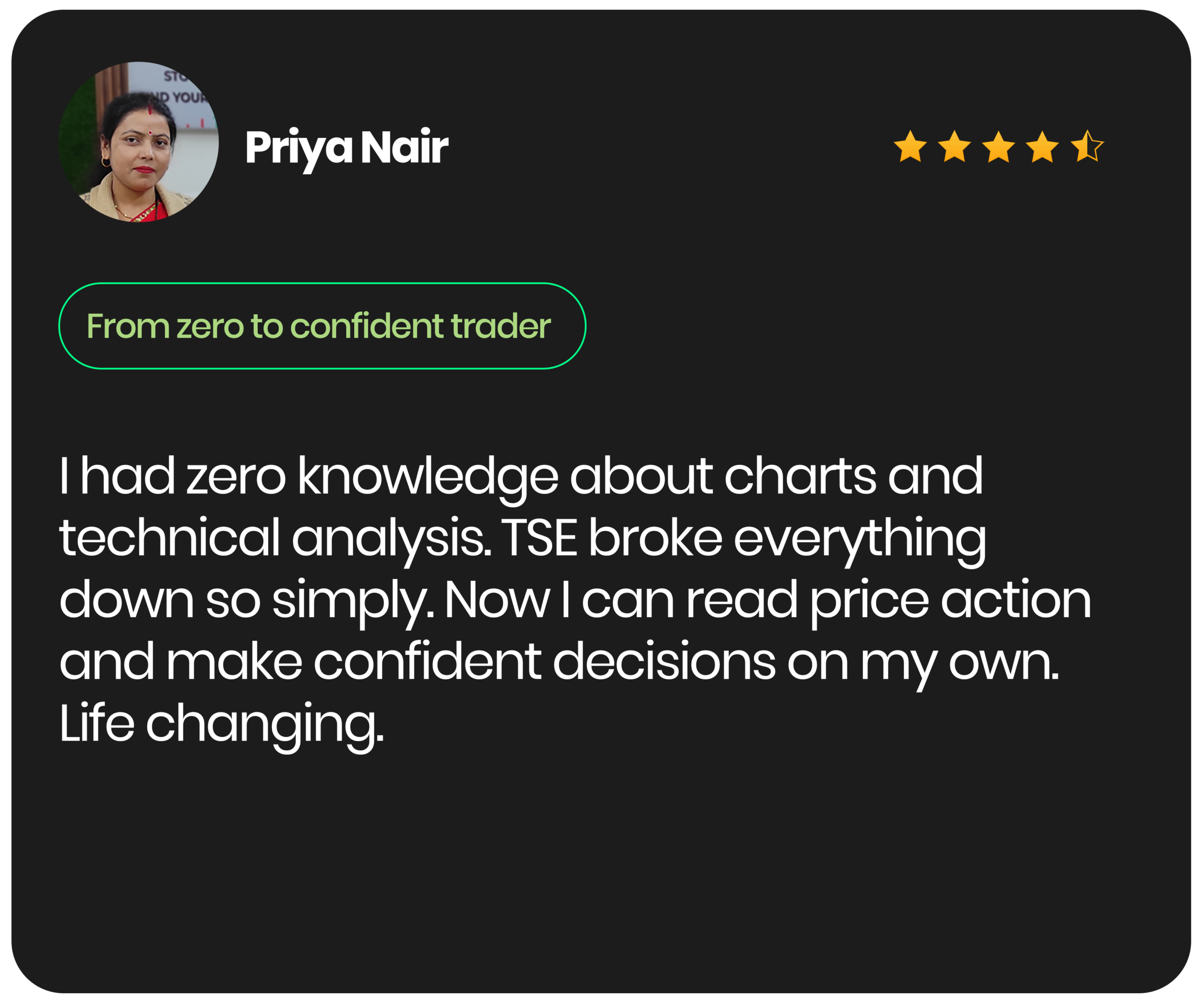
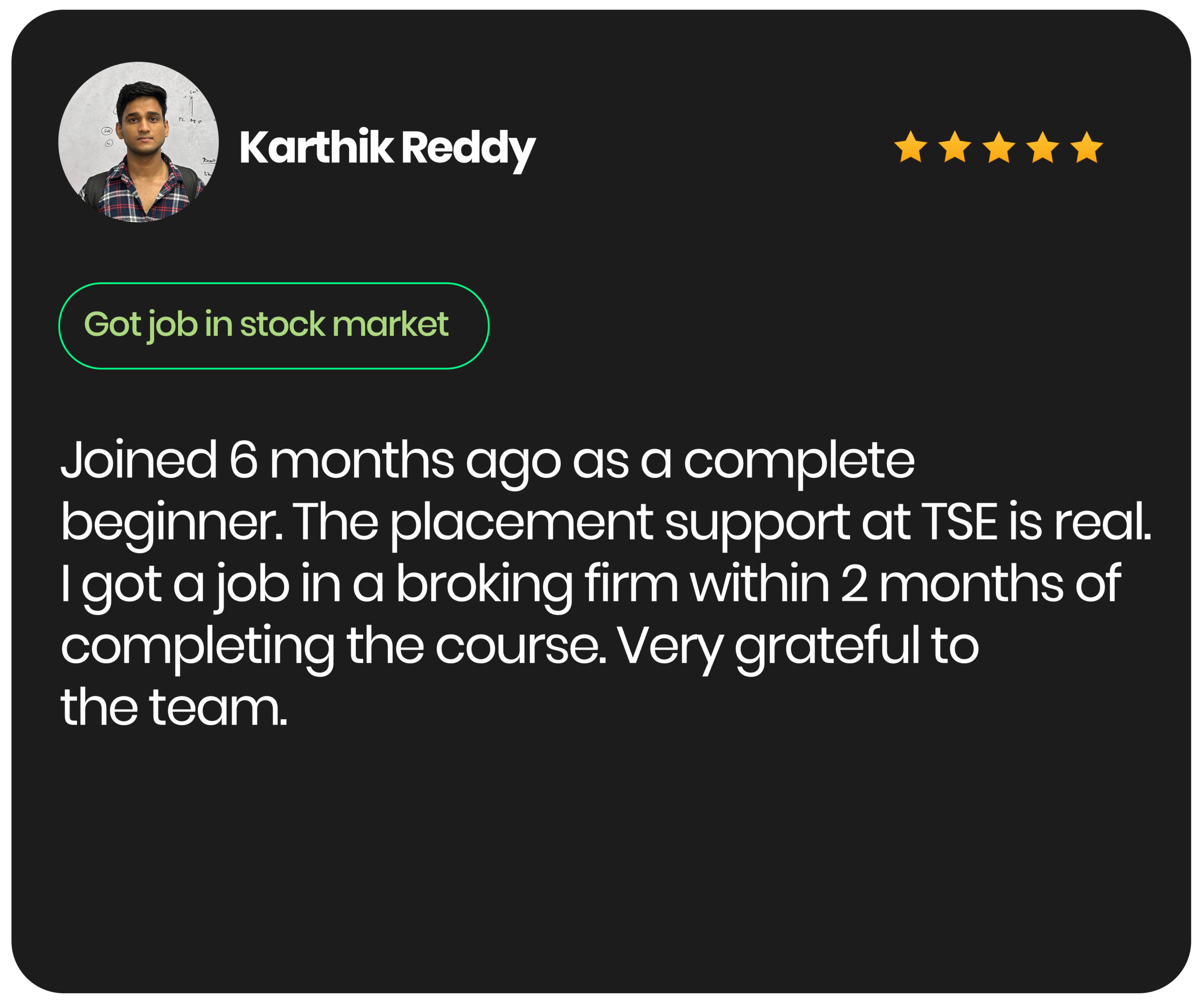
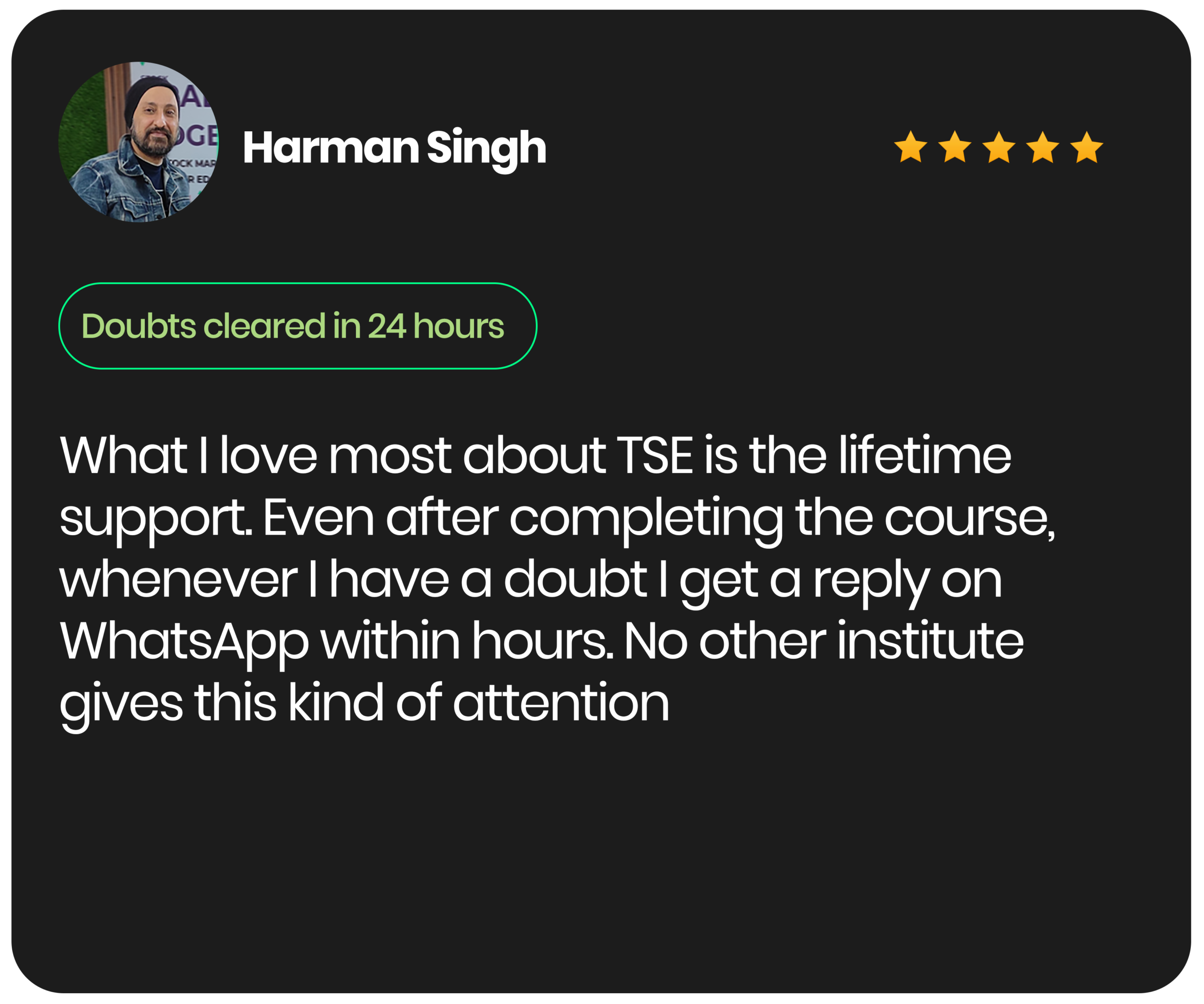
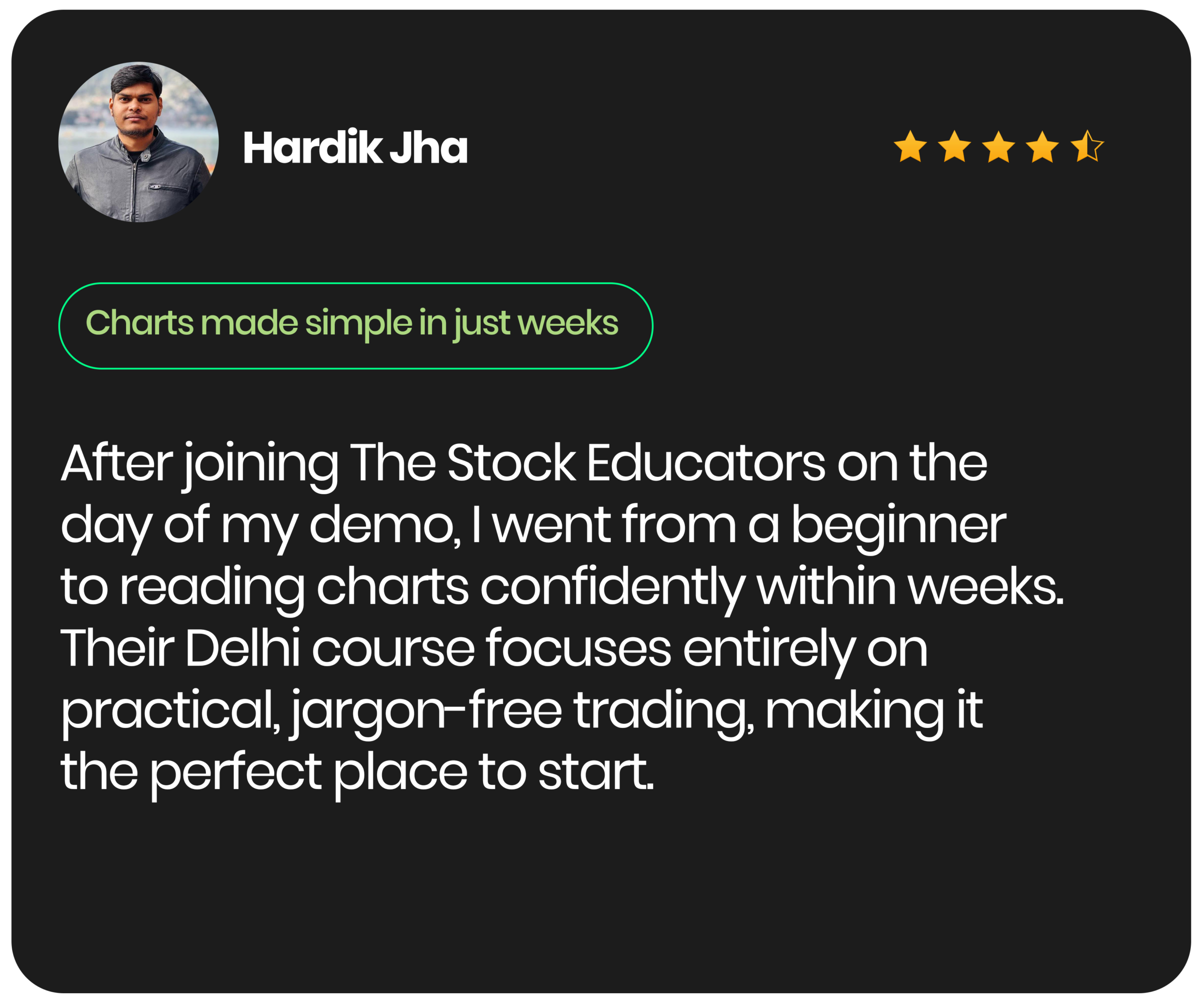
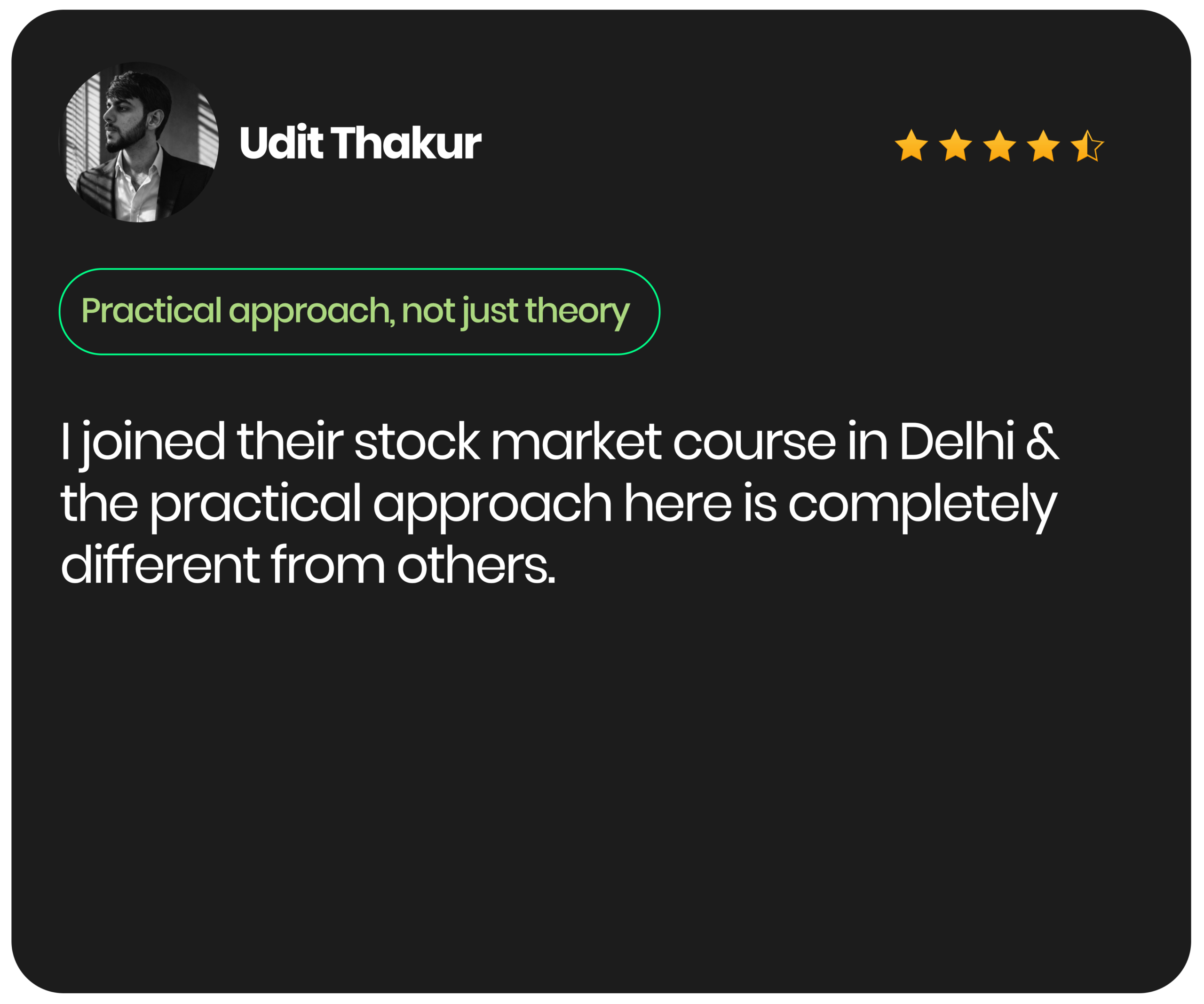
Student Success Story

Real Results from Real Students

Frequently Asked Questions

Absolutely. We don't rush into complex trades. The course starts from the absolute basics in Module 1, explaining exactly what derivatives are, why options exist, and the mechanical differences between calls and puts. Whether you are a complete beginner or struggling with consistency, we build your foundation before moving to advanced concepts.

We teach both, but with complete transparency. Early in the course, we cover the honest reality of option buying versus option selling so you have realistic expectations. You will learn directional buying (long calls/puts) as well as directional selling and income-generating strategies like covered calls and cash-secured puts.

Survival in the market comes first. We have a dedicated "survival module" on Day 7 that covers risk per trade, position sizing, and the difference between defined-risk and undefined-risk trades. We also teach you how to handle margin requirements (SPAN + exposure) and protect your capital from gap or black-swan risks.

Yes, and we don't save it for the very end of the course! Adjustment techniques are taught right alongside short-premium strategies like straddles and strangles when you actually need them. You will learn exactly how to defend a losing position, including how to roll and manage an Iron Condor.

Definitely. You don't need to buy a separate technical analysis course. Modules 4 and 5 extensively cover pure price action, Dow Theory, support/resistance, and candlestick chart patterns. More importantly, we teach "critical framing"—ensuring you only trade these candlestick patterns at key levels with volume confirmation, rather than in a vacuum.

The Greeks are so important that we split them across two full days so no single class feels overloaded. You will build a deep intuition for how Delta affects direction, how Gamma changes your exposure, and how Theta (time decay) acts as the buyer's enemy but the seller's income.

Yes, Module 9 provides specific, scenario-based playbooks specifically for intraday traders. We will teach you exactly how to read and execute trades during gap-up, gap-down, and flat or range-bound market openings. Every single setup is rigorously backtested on historical sessions during the class.

For those who can't watch the screen all day, Day 21 is entirely focused on a Delta-Neutral Monthly Strategy. We teach you how to build a monthly position step-by-step, re-hedge as the underlying asset moves, and capture time decay (Theta) safely while managing your margin.

Theory is just the beginning. Days 25 to 29 of the curriculum are exclusively dedicated to Practical and Live Trading. You will apply everything you've learned—from reading the NSE option chain to executing vertical spreads—in real-time, live market conditions.

On Capstone and Graduation day (Day 30), every student presents a backtested strategy complete with written risk rules and a reviewed trade journal. You won't leave empty-handed; you will walk away with your own personalized trading plan, fully reviewed and officially signed off by us.

Options are powerful derivatives that give you the right to buy or sell an asset without the obligation. However, most retail traders in India buy NIFTY or BANKNIFTY options blindly without understanding pricing, the Greeks, or expiry mechanics, leading to consistent losses. A structured course teaches you the complete professional framework—from understanding how premium decays to building defined-risk strategies used by experts on the NSE.

Yes, absolutely! Our Online Option Mastery Course is designed for students across India. Whether you are based in Mumbai, Bengaluru, Hyderabad, Pune, or any other city, you can attend live interactive sessions from your home or office. The online batch follows the exact same curriculum, live market sessions, and mentor guidance as our Delhi classroom.

No prior experience is necessary. The course is built from the ground up for absolute beginners. We start with the core basics—explaining what derivatives are, how calls and puts work, and how to read the NSE option chain. By Day 4, you will have a solid, working knowledge of market mechanics.

We cover over 11 complete, professional strategies with detailed payoff analysis, including:
● Directional Trades: Long/Short Calls & Puts
● Income Strategies: Covered Call, Cash-Secured Put, Protective Put
● Spreads: Bull/Bear Call & Put Spreads
● Volatility Trades: Straddles, Strangles, and Iron Condors
● Advanced: Delta-neutral monthly income positions
● Crucially, we don't just teach the setups; we teach live adjustment techniques for defending short-premium strategies when the market moves against you.

YouTube videos provide fragmented knowledge without market context. TSE’s program is a 30-session, structured live curriculum where every class connects to the next. You get live NIFTY/BANKNIFTY market analysis, personal reviews of your actual trades, and direct access to a mentor who trades the same strategies he teaches. This level of accountability, strategy backtesting, and live feedback is impossible to get from pre-recorded videos.

Options trading is completely legal for individuals in India through SEBI-registered brokers, and no certification is required for personal trading. However, if you wish to build a career as a Research Analyst, Stock Broker, or Investment Advisor, NISM certification is mandatory. Our course curriculum fully prepares you to clear the NISM Series VIII (Equity Derivatives) examination.

You won't just learn theory; you will learn to use the tools professionals rely on. We train you on the NSE Option Chain for open interest and volume analysis, Sensibull or Opstra for building and visualizing strategy payoffs, and TradingView for advanced charting. You will also use TSE’s proprietary trade plan and journal templates to backtest your strategies before going live.

To ensure personalized attention, our online batches are capped at a maximum of 15 students. This guarantees direct mentor interaction and individual trade journal feedback—not a crowded mass-lecture experience. The program spans 30 live sessions (approx. 6 to 8 weeks) with both weekday and weekend options.