
Master F&O Trading
from anywhere in India.
The majority of traders incur losses due to lack of knowledge. Stop risking capital blindly. Build real money trading setups based on NSE data with our 30-session live online course.
The majority of traders incur losses due to lack of knowledge. Stop risking capital blindly.
Build real money trading setups based on NSE data with our 30-session live online course.
Master F&O Trading
from anywhere in India.
The majority of traders incur losses due to lack of knowledge. Stop risking capital blindly.
Build real money trading setups based on NSE data with our 30-session live online course.
What Is the Online Option Mastery Course at TSE?
Online Options Mastery Course is TSE's exclusive F&O training course conducted live by Hemant Sharma, a SEBI Registered Research Analyst with over 10 years of experience in trading NIFTY, BANKNIFTY, and FINNIFTY options.
This advanced program is designed for traders who want to learn professional options trading strategies beyond random buying and selling.
By the end of the course, you will have a complete Trading Plan, Trade Journal, Backtested Strategy, and Risk Management Framework.
30
Live Online Sessions
11
Deep Dive Modules
10+
Years Mentor Experience
100%
Practical Learning
Who Should Join This Mastery Course?
Existing F&O Traders
You are already trading options but losing money or winning inconsistently. This course identifies exactly what is missing: Greeks, sizing, and adjustment techniques.
Stock Investors
Learn how to use covered calls and protective puts to generate income and reduce downside risk in your portfolio.
Complete Beginners
No experience needed. The first seven sessions build every concept from scratch before any strategy is introduced.
Working Professionals
Attend live online evening and weekend batches from home, office, or anywhere in India.
Finance Students (CA/CFA/MBA)
Gain practical NSE market exposure and NISM Series VIII preparation beyond classroom theory.
Business Owners & HNIs
Learn portfolio hedging, income generation, and capital protection with professional risk management.
Students Outside Metro Cities
Access the same quality education from Tier-2 and Tier-3 cities without relocating or travelling.
- Loved. Trusted. United by Greatness.
Download Course Brochure
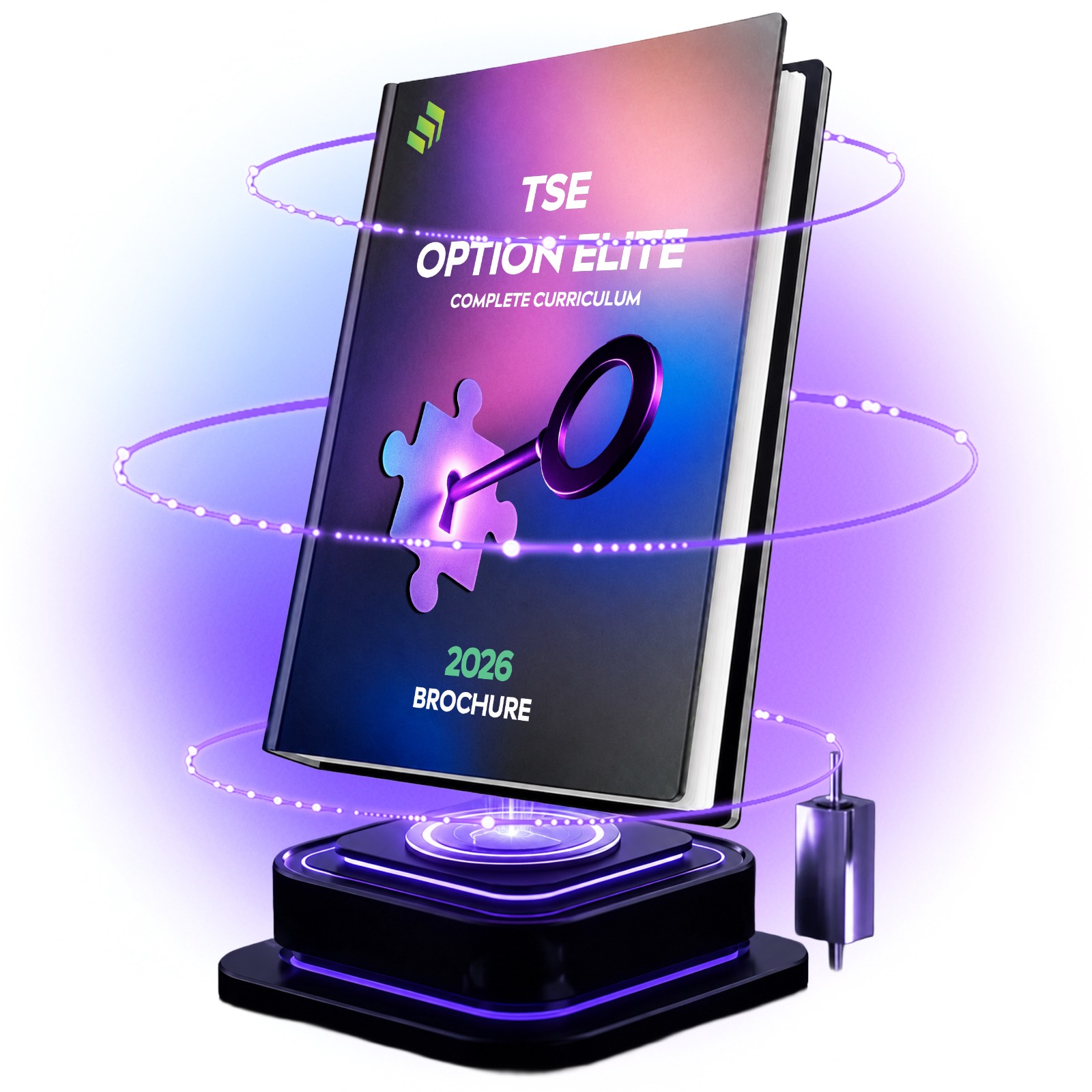
Explore the complete TSE Option Elite Program
Including curriculum, mentorship roadmap, live trading sessions, bonuses, certification, pricing and FAQs in one professionally designed PDF.
Complete Curriculum
Live Mentorship Program
Trading Strategies
Bonuses & Resources
- 100% Secure
- No Spam
- Instant Download
Full 30 Day Curriculum
11 structured modules. Each session is delivered live online. Every class builds on the previous one.
From Day 7 onward every session includes a live market component on NIFTY or BANKNIFTY.
- Used by over 98,000 Traders
- MODULE 1
Derivatives & Options Foundations (Day 1-4)
Day 1 — Derivatives & why options exist
- What exactly are derivatives?
- A clear comparison between forwards, futures, and options to build your base.
- Why do options even exist?
- Exploring their real-world purpose, including hedging, speculation, and generating income.
- How do futures and options stack up against each other?
- Breaking down the differences in their risk profiles and required capital.
- What does the Indian F&O landscape look like?
- Navigating through NIFTY, BANKNIFTY, FINNIFTY, stock options, and understanding weekly vs monthly expiry.
- What is the honest reality of option buying versus selling?
- Setting clear, realistic expectations right from the very start.
Day 2 — Calls & puts mechanics
- How do call and put options actually work?
- Understanding the specific rights and obligations of both the buyer and the seller.
- What do these core pricing terms mean?
- Simplifying strike price, spot price, and premium.
- How do we define moneyness?
- Breaking down ITM (In The Money), ATM (At The Money), and OTM (Out of The Money) for both calls and puts.
- How does leverage truly function here?
- Deep dive into lot sizes, contract values, and the reality of leverage.
Day 3 — Reading the option chain
- How do you navigate the NSE option chain?
- An end-to-end guide on reading the chain effectively.
- What do all those data columns mean?
- Demystifying the bid/ask, LTP, volume, and open interest columns.
- How do you choose the right expiry and handle settlement?
- Understanding cash-settled indices and how STT (Securities Transaction Tax) works on the sell side.
- What is the expiry-day ITM STT trap?
- Learning what this trap is and why it is absolutely critical to avoid it.
Day 4 — Premium decomposition
- What is hiding inside an option’s premium?
- Separating the intrinsic value from the time value.
- How does the premium decay as we get closer to expiry?
- A gentle introduction to theta, which we formalise later on Day 6.
- How do you know if a premium is expensive or cheap?
- Understanding the factors that drive option pricing.
- Why is liquidity a trader’s best friend?
- Learning why you should stick to index and liquid stock options while avoiding wide bid-ask spreads.
- MODULE 2
Greeks, Volatility, Risk & Margin (Day 5-7)
Day 5 — Greeks I: Delta & Gamma
- What is Delta and why does it matter?
- Building a strong intuition for your directional exposure and the probability of your trades.
- What is Gamma?
- Understanding the engine behind Delta and how delta itself changes.
- How do we use Delta practically?
- Applying it to choose the right strikes and to evaluate your position risk.
Day 6 — Greeks II + volatility
- What is Theta?
- Understanding time decay, which acts as the buyer’s worst enemy and the seller’s primary income source.
- What are Vega and Rho?
- Learning about sensitivity to volatility (Vega) and taking a brief look at interest rates (Rho).
- How do implied and historical volatility differ?
- Diving into IV rank/percentile, the India VIX, and understanding exactly what it signals to the market.
Day 7 — Risk, money management & margins (the survival module)
- How do you protect your capital?
- Mastering risk per trade, position sizing, and understanding the difference between defined-risk and undefined-risk trades.
- How do margins and risk asymmetry work?
- Exploring SPAN + exposure, why selling requires large margin, the risk asymmetry between buyers and sellers, and managing gap or black-swan risk for sellers.
- How do you track your journey?
- Setting up the options trade-plan and trade-journal templates, along with establishing the weekly/monthly review loop that you will use from here on out.
- MODULE 3
Open Interest & Market View (Day 8)
- What exactly are derivatives?A clear comparison between forwards, futures, and options to build your base.
- Why do options even exist?Exploring their real-world purpose, including hedging, speculation, and generating income.
- How do futures and options stack up against each other?Breaking down the differences in their risk profiles and required capital.
- What does the Indian F&O landscape look like?Navigating through NIFTY, BANKNIFTY, FINNIFTY, stock options, and understanding weekly vs monthly expiry.
- What is the honest reality of option buying versus selling?Setting clear, realistic expectations right from the very start.
- How do call and put options actually work?Understanding the specific rights and obligations of both the buyer and the seller.
- What do these core pricing terms mean?Simplifying strike price, spot price, and premium.
- How do we define moneyness?Breaking down ITM (In The Money), ATM (At The Money), and OTM (Out of The Money) for both calls and puts.
- How does leverage truly function here?Deep dive into lot sizes, contract values, and the reality of leverage.
- How do you navigate the NSE option chain?An end-to-end guide on reading the chain effectively.
- What do all those data columns mean?Demystifying the bid/ask, LTP, volume, and open interest columns.
- How do you choose the right expiry and handle settlement?Understanding cash-settled indices and how STT (Securities Transaction Tax) works on the sell side.
- What is the expiry-day ITM STT trap?Learning what this trap is and why it is absolutely critical to avoid it.
- What is hiding inside an option’s premium?Separating the intrinsic value from the time value.
- How does the premium decay as we get closer to expiry?A gentle introduction to theta, which we formalise later on Day 6.
- How do you know if a premium is expensive or cheap?Understanding the factors that drive option pricing.
- Why is liquidity a trader’s best friend?Learning why you should stick to index and liquid stock options while avoiding wide bid-ask spreads.
- MODULE 4
Technical Analysis: Price-Action Core (Day 9-11)
- What exactly are derivatives?A clear comparison between forwards, futures, and options to build your base.
- Why do options even exist?Exploring their real-world purpose, including hedging, speculation, and generating income.
- How do futures and options stack up against each other?Breaking down the differences in their risk profiles and required capital.
- What does the Indian F&O landscape look like?Navigating through NIFTY, BANKNIFTY, FINNIFTY, stock options, and understanding weekly vs monthly expiry.
- What is the honest reality of option buying versus selling?Setting clear, realistic expectations right from the very start.
- How do call and put options actually work?Understanding the specific rights and obligations of both the buyer and the seller.
- What do these core pricing terms mean?Simplifying strike price, spot price, and premium.
- How do we define moneyness?Breaking down ITM (In The Money), ATM (At The Money), and OTM (Out of The Money) for both calls and puts.
- How does leverage truly function here?Deep dive into lot sizes, contract values, and the reality of leverage.
- How do you navigate the NSE option chain?An end-to-end guide on reading the chain effectively.
- What do all those data columns mean?Demystifying the bid/ask, LTP, volume, and open interest columns.
- How do you choose the right expiry and handle settlement?Understanding cash-settled indices and how STT (Securities Transaction Tax) works on the sell side.
- What is the expiry-day ITM STT trap?Learning what this trap is and why it is absolutely critical to avoid it.
- What is hiding inside an option’s premium?Separating the intrinsic value from the time value.
- How does the premium decay as we get closer to expiry?A gentle introduction to theta, which we formalise later on Day 6.
- How do you know if a premium is expensive or cheap?Understanding the factors that drive option pricing.
- Why is liquidity a trader’s best friend?Learning why you should stick to index and liquid stock options while avoiding wide bid-ask spreads.
- MODULE 5
Patterns: Candlesticks & Chart Patterns (Day 12-15)
- What exactly are derivatives?A clear comparison between forwards, futures, and options to build your base.
- Why do options even exist?Exploring their real-world purpose, including hedging, speculation, and generating income.
- How do futures and options stack up against each other?Breaking down the differences in their risk profiles and required capital.
- What does the Indian F&O landscape look like?Navigating through NIFTY, BANKNIFTY, FINNIFTY, stock options, and understanding weekly vs monthly expiry.
- What is the honest reality of option buying versus selling?Setting clear, realistic expectations right from the very start.
- How do call and put options actually work?Understanding the specific rights and obligations of both the buyer and the seller.
- What do these core pricing terms mean?Simplifying strike price, spot price, and premium.
- How do we define moneyness?Breaking down ITM (In The Money), ATM (At The Money), and OTM (Out of The Money) for both calls and puts.
- How does leverage truly function here?Deep dive into lot sizes, contract values, and the reality of leverage.
- How do you navigate the NSE option chain?An end-to-end guide on reading the chain effectively.
- What do all those data columns mean?Demystifying the bid/ask, LTP, volume, and open interest columns.
- How do you choose the right expiry and handle settlement?Understanding cash-settled indices and how STT (Securities Transaction Tax) works on the sell side.
- What is the expiry-day ITM STT trap?Learning what this trap is and why it is absolutely critical to avoid it.
- What is hiding inside an option’s premium?Separating the intrinsic value from the time value.
- How does the premium decay as we get closer to expiry?A gentle introduction to theta, which we formalise later on Day 6.
- How do you know if a premium is expensive or cheap?Understanding the factors that drive option pricing.
- Why is liquidity a trader’s best friend?Learning why you should stick to index and liquid stock options while avoiding wide bid-ask spreads.
- MODULE 6
Foundational Option Strategies (Day 16-18)
- What exactly are derivatives?A clear comparison between forwards, futures, and options to build your base.
- Why do options even exist?Exploring their real-world purpose, including hedging, speculation, and generating income.
- How do futures and options stack up against each other?Breaking down the differences in their risk profiles and required capital.
- What does the Indian F&O landscape look like?Navigating through NIFTY, BANKNIFTY, FINNIFTY, stock options, and understanding weekly vs monthly expiry.
- What is the honest reality of option buying versus selling?Setting clear, realistic expectations right from the very start.
- How do call and put options actually work?Understanding the specific rights and obligations of both the buyer and the seller.
- What do these core pricing terms mean?Simplifying strike price, spot price, and premium.
- How do we define moneyness?Breaking down ITM (In The Money), ATM (At The Money), and OTM (Out of The Money) for both calls and puts.
- How does leverage truly function here?Deep dive into lot sizes, contract values, and the reality of leverage.
- How do you navigate the NSE option chain?An end-to-end guide on reading the chain effectively.
- What do all those data columns mean?Demystifying the bid/ask, LTP, volume, and open interest columns.
- How do you choose the right expiry and handle settlement?Understanding cash-settled indices and how STT (Securities Transaction Tax) works on the sell side.
- What is the expiry-day ITM STT trap?Learning what this trap is and why it is absolutely critical to avoid it.
- What is hiding inside an option’s premium?Separating the intrinsic value from the time value.
- How does the premium decay as we get closer to expiry?A gentle introduction to theta, which we formalise later on Day 6.
- How do you know if a premium is expensive or cheap?Understanding the factors that drive option pricing.
- Why is liquidity a trader’s best friend?Learning why you should stick to index and liquid stock options while avoiding wide bid-ask spreads.
- MODULE 7
Neutral & Volatility Strategies (Day 19-20)
- What exactly are derivatives?A clear comparison between forwards, futures, and options to build your base.
- Why do options even exist?Exploring their real-world purpose, including hedging, speculation, and generating income.
- How do futures and options stack up against each other?Breaking down the differences in their risk profiles and required capital.
- What does the Indian F&O landscape look like?Navigating through NIFTY, BANKNIFTY, FINNIFTY, stock options, and understanding weekly vs monthly expiry.
- What is the honest reality of option buying versus selling?Setting clear, realistic expectations right from the very start.
- How do call and put options actually work?Understanding the specific rights and obligations of both the buyer and the seller.
- What do these core pricing terms mean?Simplifying strike price, spot price, and premium.
- How do we define moneyness?Breaking down ITM (In The Money), ATM (At The Money), and OTM (Out of The Money) for both calls and puts.
- How does leverage truly function here?Deep dive into lot sizes, contract values, and the reality of leverage.
- How do you navigate the NSE option chain?An end-to-end guide on reading the chain effectively.
- What do all those data columns mean?Demystifying the bid/ask, LTP, volume, and open interest columns.
- How do you choose the right expiry and handle settlement?Understanding cash-settled indices and how STT (Securities Transaction Tax) works on the sell side.
- What is the expiry-day ITM STT trap?Learning what this trap is and why it is absolutely critical to avoid it.
- What is hiding inside an option’s premium?Separating the intrinsic value from the time value.
- How does the premium decay as we get closer to expiry?A gentle introduction to theta, which we formalise later on Day 6.
- How do you know if a premium is expensive or cheap?Understanding the factors that drive option pricing.
- Why is liquidity a trader’s best friend?Learning why you should stick to index and liquid stock options while avoiding wide bid-ask spreads.
- MODULE 8
Delta-Neutral Monthly Strategy (Day 21)
- What exactly are derivatives?A clear comparison between forwards, futures, and options to build your base.
- Why do options even exist?Exploring their real-world purpose, including hedging, speculation, and generating income.
- How do futures and options stack up against each other?Breaking down the differences in their risk profiles and required capital.
- What does the Indian F&O landscape look like?Navigating through NIFTY, BANKNIFTY, FINNIFTY, stock options, and understanding weekly vs monthly expiry.
- What is the honest reality of option buying versus selling?Setting clear, realistic expectations right from the very start.
- How do call and put options actually work?Understanding the specific rights and obligations of both the buyer and the seller.
- What do these core pricing terms mean?Simplifying strike price, spot price, and premium.
- How do we define moneyness?Breaking down ITM (In The Money), ATM (At The Money), and OTM (Out of The Money) for both calls and puts.
- How does leverage truly function here?Deep dive into lot sizes, contract values, and the reality of leverage.
- How do you navigate the NSE option chain?An end-to-end guide on reading the chain effectively.
- What do all those data columns mean?Demystifying the bid/ask, LTP, volume, and open interest columns.
- How do you choose the right expiry and handle settlement?Understanding cash-settled indices and how STT (Securities Transaction Tax) works on the sell side.
- What is the expiry-day ITM STT trap?Learning what this trap is and why it is absolutely critical to avoid it.
- What is hiding inside an option’s premium?Separating the intrinsic value from the time value.
- How does the premium decay as we get closer to expiry?A gentle introduction to theta, which we formalise later on Day 6.
- How do you know if a premium is expensive or cheap?Understanding the factors that drive option pricing.
- Why is liquidity a trader’s best friend?Learning why you should stick to index and liquid stock options while avoiding wide bid-ask spreads.
- MODULE 9
Situational Institutions Intraday Strategies (Day 22-24)
- What exactly are derivatives?A clear comparison between forwards, futures, and options to build your base.
- Why do options even exist?Exploring their real-world purpose, including hedging, speculation, and generating income.
- How do futures and options stack up against each other?Breaking down the differences in their risk profiles and required capital.
- What does the Indian F&O landscape look like?Navigating through NIFTY, BANKNIFTY, FINNIFTY, stock options, and understanding weekly vs monthly expiry.
- What is the honest reality of option buying versus selling?Setting clear, realistic expectations right from the very start.
- How do call and put options actually work?Understanding the specific rights and obligations of both the buyer and the seller.
- What do these core pricing terms mean?Simplifying strike price, spot price, and premium.
- How do we define moneyness?Breaking down ITM (In The Money), ATM (At The Money), and OTM (Out of The Money) for both calls and puts.
- How does leverage truly function here?Deep dive into lot sizes, contract values, and the reality of leverage.
- How do you navigate the NSE option chain?An end-to-end guide on reading the chain effectively.
- What do all those data columns mean?Demystifying the bid/ask, LTP, volume, and open interest columns.
- How do you choose the right expiry and handle settlement?Understanding cash-settled indices and how STT (Securities Transaction Tax) works on the sell side.
- What is the expiry-day ITM STT trap?Learning what this trap is and why it is absolutely critical to avoid it.
- What is hiding inside an option’s premium?Separating the intrinsic value from the time value.
- How does the premium decay as we get closer to expiry?A gentle introduction to theta, which we formalise later on Day 6.
- How do you know if a premium is expensive or cheap?Understanding the factors that drive option pricing.
- Why is liquidity a trader’s best friend?Learning why you should stick to index and liquid stock options while avoiding wide bid-ask spreads.
- MODULE 10
Practical / Live Trading (Day 25-29)
- What exactly are derivatives?A clear comparison between forwards, futures, and options to build your base.
- Why do options even exist?Exploring their real-world purpose, including hedging, speculation, and generating income.
- How do futures and options stack up against each other?Breaking down the differences in their risk profiles and required capital.
- What does the Indian F&O landscape look like?Navigating through NIFTY, BANKNIFTY, FINNIFTY, stock options, and understanding weekly vs monthly expiry.
- What is the honest reality of option buying versus selling?Setting clear, realistic expectations right from the very start.
- How do call and put options actually work?Understanding the specific rights and obligations of both the buyer and the seller.
- What do these core pricing terms mean?Simplifying strike price, spot price, and premium.
- How do we define moneyness?Breaking down ITM (In The Money), ATM (At The Money), and OTM (Out of The Money) for both calls and puts.
- How does leverage truly function here?Deep dive into lot sizes, contract values, and the reality of leverage.
- How do you navigate the NSE option chain?An end-to-end guide on reading the chain effectively.
- What do all those data columns mean?Demystifying the bid/ask, LTP, volume, and open interest columns.
- How do you choose the right expiry and handle settlement?Understanding cash-settled indices and how STT (Securities Transaction Tax) works on the sell side.
- What is the expiry-day ITM STT trap?Learning what this trap is and why it is absolutely critical to avoid it.
- What is hiding inside an option’s premium?Separating the intrinsic value from the time value.
- How does the premium decay as we get closer to expiry?A gentle introduction to theta, which we formalise later on Day 6.
- How do you know if a premium is expensive or cheap?Understanding the factors that drive option pricing.
- Why is liquidity a trader’s best friend?Learning why you should stick to index and liquid stock options while avoiding wide bid-ask spreads.
- MODULE 11
Capstone & Graduation (Day 30)
- What exactly are derivatives?A clear comparison between forwards, futures, and options to build your base.
- Why do options even exist?Exploring their real-world purpose, including hedging, speculation, and generating income.
- How do futures and options stack up against each other?Breaking down the differences in their risk profiles and required capital.
- What does the Indian F&O landscape look like?Navigating through NIFTY, BANKNIFTY, FINNIFTY, stock options, and understanding weekly vs monthly expiry.
- What is the honest reality of option buying versus selling?Setting clear, realistic expectations right from the very start.
- How do call and put options actually work?Understanding the specific rights and obligations of both the buyer and the seller.
- What do these core pricing terms mean?Simplifying strike price, spot price, and premium.
- How do we define moneyness?Breaking down ITM (In The Money), ATM (At The Money), and OTM (Out of The Money) for both calls and puts.
- How does leverage truly function here?Deep dive into lot sizes, contract values, and the reality of leverage.
- How do you navigate the NSE option chain?An end-to-end guide on reading the chain effectively.
- What do all those data columns mean?Demystifying the bid/ask, LTP, volume, and open interest columns.
- How do you choose the right expiry and handle settlement?Understanding cash-settled indices and how STT (Securities Transaction Tax) works on the sell side.
- What is the expiry-day ITM STT trap?Learning what this trap is and why it is absolutely critical to avoid it.
- What is hiding inside an option’s premium?Separating the intrinsic value from the time value.
- How does the premium decay as we get closer to expiry?A gentle introduction to theta, which we formalise later on Day 6.
- How do you know if a premium is expensive or cheap?Understanding the factors that drive option pricing.
- Why is liquidity a trader’s best friend?Learning why you should stick to index and liquid stock options while avoiding wide bid-ask spreads.
Amazing Rewards Worth Thousands
Compete for free and access rewards that elevate your trading journey
Cash Rewards
Performance-based cash distributions for top performers
Free Trading Accounts
Instant access to funded accounts with simulated capital
Premium Physical Prizes
Luxury items including watches, electronics, and exclusive merchandise
tech & Gadgets
iPhones, iPads, MacBooks, and cutting-edge trading equipment
- Used by over 98,000 Traders
Up to $5,000
in single competition cash rewards
Up to $5,000
in single competition cash rewards
Up to $5,000
in single competition cash rewards
Up to $5,000
in single competition cash rewards
Up to $5,000
in single competition cash rewards
Up to $5,000
in single competition cash rewards
Free Funded Accounts
with no evaluation required
How to Join the Free Competition
01
Register
Register for your GFT account with your email. No payment required. Then navigate to the competition page to sign up.
02
Trade & Compete
Register for your GFT account with your email. No payment required. Then navigate to the competition page to sign up.
03
Claim rewards
Register for your GFT account with your email. No payment required. Then navigate to the competition page to sign up.
- Used by over 98,000 Traders
Up to $5,000
in single competition cash rewards
Up to $5,000
in single competition cash rewards
Up to $5,000
in single competition cash rewards
Up to $5,000
in single competition cash rewards
Up to $5,000
in single competition cash rewards
Up to $5,000
in single competition cash rewards
Trade with your favourite Platforms





- Used by over 98,000 Traders
- Loved. Trusted. United by Greatness.
Join the 250+ Thousand Traders who trust GFT
- 4.8 Stars from 5k verified Reviews







Frequently Asked Questions
1. I am new to F&O. Is the Option Mastery Course suitable for beginners?
Absolutely. We don’t rush into complex trades. The course starts from the absolute basics in Module 1, explaining exactly what derivatives are, why options exist, and the mechanical differences between calls and puts. Whether you are a complete beginner or struggling with consistency, we build your foundation before moving to advanced concepts.
2. Does this program focus on Option Buying or Option Selling?
We teach both, but with complete transparency. Early in the course, we cover the honest reality of option buying versus option selling so you have realistic expectations. You will learn directional buying (long calls/puts) as well as directional selling and income-generating strategies like covered calls and cash-secured puts.
3. Options trading is considered risky. How do you teach risk?
Survival in the market comes first. We have a dedicated “survival module” on Day 7 that covers risk per trade, position sizing, and the difference between defined-risk and undefined-risk trades. We also teach you how to handle margin requirements (SPAN + exposure) and protect your capital from gap or black-swan risks.
4. What if the market moves against my trade? Do you teach option adjustments?
Yes, and we don’t save it for the very end of the course! Adjustment techniques are taught right alongside short-premium strategies like straddles and strangles when you actually need them. You will learn exactly how to defend a losing position, including how to roll and manage an Iron Condor.
5. Will I learn how to read charts and technical analysis in this course?
Definitely. You don’t need to buy a separate technical analysis course. Modules 4 and 5 extensively cover pure price action, Dow Theory, support/resistance, and candlestick chart patterns. More importantly, we teach “critical framing” ensuring you only trade these candlestick patterns at key levels with volume confirmation, rather than in a vacuum.
6. I struggle with the Option Greeks (Delta, Theta, etc.). Are they covered in detail?
The Greeks are so important that we split them across two full days so no single class feels overloaded. You will build a deep intuition for how Delta affects direction, how Gamma changes your exposure, and how Theta (time decay) acts as the buyer’s enemy but the seller’s income.
7. Does the course include intraday trading strategies?
Yes, Module 9 provides specific, scenario-based playbooks specifically for intraday traders. We will teach you exactly how to read and execute trades during gap-up, gap-down, and flat or range-bound market openings. Every single setup is rigorously backtested on historical sessions during the class.
8. I am a working professional. Are there strategies for passive income?
For those who can’t watch the screen all day, Day 21 is entirely focused on a Delta-Neutral Monthly Strategy. We teach you how to build a monthly position step-by-step, re-hedge as the underlying asset moves, and capture time decay (Theta) safely while managing your margin.
9. Is there any live market practice, or is it mostly theory?
Theory is just the beginning. Days 25 to 29 of the curriculum are exclusively dedicated to Practical and Live Trading. You will apply everything you’ve learned from reading the NSE option chain to executing vertical spreads in real-time, live market conditions.
10. What happens at the end of the 30-day program?
On Capstone and Graduation day (Day 30), every student presents a backtested strategy complete with written risk rules and a reviewed trade journal. You won’t leave empty-handed; you will walk away with your own personalized trading plan, fully reviewed and officially signed off by us.
- Used by over 98,000 Traders
Course Overview — At a Glance
Course Comparison Matrix
Explore elite trading programs designed to build professional clarity
Detailed Course Feature Breakdown
| Feature / Topic | TSE Option Elite | TSE Swing Elite | TSE Combo Pro Elite | Offline Course 2.0 |
|---|---|---|---|---|
| Market & Investing Foundations | ||||
| Basic of Stock Market (Primary & Secondary Market) | ✗ | ✓ | ✓ | ✓ |
| Technical Analysis – Price-Action Core | ||||
| Dow Theory & The Big Whale (proprietary module) | ✓ | ✓ | ✓ | ✓ |
| Marking support & resistance, demand/supply | ✓ | ✓ | ✓ | ✓ |
| Time Study & Multi-timeframe analysis | ✓ | ✓ | ✓ | ✓ |
| Candlestick & ChartPattern Setups | ✓ | ✓ | ✓ | ✓ |
| Intraday Trading Setups | ||||
| Option Intraday Scalping Trading Strategy | ✓ | ✗ | ✓ | ✓ |
| Option Swing Trading Strategy | ✓ | ✗ | ✓ | ✓ |
| Option Delta Neutral Based Adjustment Strategy | ✓ | ✗ | ✓ | ✓ |
| Swing Trading Setups | ||||
| Stock Intraday Trading Strategy | ✗ | ✓ | ✓ | ✓ |
| Stock Swing Trading Strategy | ✗ | ✓ | ✓ | ✓ |
| Stock Multibegger Identification Strategy | ✗ | ✓ | ✓ | ✓ |
| Time Study - The Explosion Moves Flagship Setup | ✗ | ✓ | ✓ | ✓ |
| Derivatives & Options Foundations | ||||
| Calls & puts mechanics (rights/obligations) | ✓ | ✗ | ✓ | ✓ |
| Reading the option chain (OI, IV, LTP) | ✓ | ✗ | ✓ | ✓ |
| Greeks, Implied vs historical vol, IV rank, India VIX | ✓ | ✗ | ✓ | ✓ |
| OI analysis (buildup/unwinding, PCR, max pain) | ✓ | ✗ | ✓ | ✓ |
| Option Strategies | ||||
| Single-leg, Double Leg, 4 Leg Strategies | ✓ | ✗ | ✓ | ✓ |
| Hedged Strategies & Margin Benefits | ✓ | ✗ | ✓ | ✓ |
| Screening, Backtesting & Automation | ||||
| Chartink & Screeners Filteration | ✗ | ✓ | ✓ | ✓ |
| 5 Days Practical with Live Trading and Learning | ✗ | ✗ | ✓ | ✓ |
| TSE Crypto Currency Elite Programme | ✗ | ✗ | ✓ | ✓ |
Trusted by Traders Worldwide
- Limited Time
Registration Closes Soon
Don’t Miss Your Chance to Win
- Used by over 98,000 Traders